Posts

Week 4: Design

Image
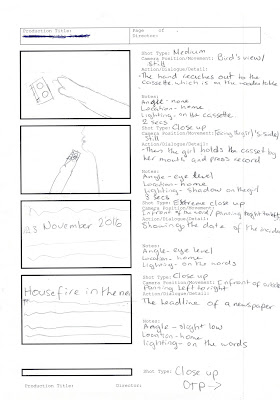
First Lesson: 13/02/17 On the first lesson, I continue brainstorming the plot of the whole tv show so I can then turin into a teaser trailer.  After writing down the summary outline of the show, I managed to have a protaganist and an antoganist. I have the killer's motives and the backstory for the viallain. This gave me an idea for the teaser trailer. I aksed Mr Andrews the updated version and he said it was good. Second Lesson: 14/02/17 I finally had the full concept for the trailer and talked to Mr Andrews about it. He was fine with the idea therefore I could start planning. Also, we were also asked to write down a character outline to have a backstory for the character we are introducing. Trailer Breakdown The trailer starts out with a tape recorder on the table and a hand is seen to take the recorder Have the tape been brought to the mouth of the girl and press play to record The girl narrates: she mentions the date and tells about an incident in which a fir...

Week 3: Photography and Brainstorm

First lesson: 6/02/17 On the first lesson of this week, we looked at the different types of editing used in films. We looked at graphic editing, rhythmic editing, spatial editing, temporal editing and how they work. Afterwards, we watched a montage clip from the film Memoirs of a Geisha to see various types of editing used in one montage. The clip used lots off graphics match, for example, the powder blush, temporal editing; the montage and rhythmic editing in which follows the music in the background.  Finally, we looked at past student's work for the first task which is creating a teaser trailer to have an idea for the concept. Second lesson: 8/02/17 On the second lesson, we looked at the principle of photography. We learned about terminologies such as shutter speed, aperture and ISO. We learned that the shutter speed is the sound we hear when we press the shutter release button to take a photo. It is the amount of time the shutter is open. We learn that if we have a fast s...

Week 2: Cinamatography and Editing

Image
On the first lesson of this week, we run through cinematography, more specifically framing. We look at types of shots and angle, rule of third and the golden triangle and how they make a shot. We then did an exercise where we have to take four pictures where a character is powerful, weak then equal. After we have finished, we had to show our image in next lesson for the class to analyse the images. On the following lesson, we showed our four images to the class and they analyse each image to see if the shots portray the equal and different powers of each images. The feedback we have been received were: For the equal images: The people in the picture are closely equal The background lighting is different from each image Have the camera in the same position so the background is the same position  For the power differences images: Powerless: The rule of Golden Triangle was used Lighting could be better such as underexpose the picture Lines used effectively well as ...

FTM Term 1: Introduction, Week 1

Image
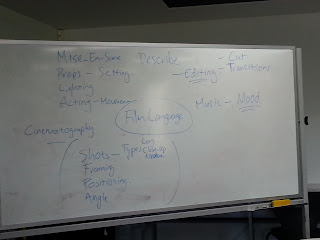
This week we run through again the film terminology and language such as mise en scene, cinematography and editing. Afterwards, we were asked to pick our favourite film we have watched in the past and write down what we liked about this film on how they use the film techniques.  The film I chose is Sherlock The Abominable Bride. The thing I like about this film is the use of mise en scene and editing. In terms of mise en scene, the props and costume matched the time period the film set in which Victorian-era England. Meanwhile, the lighting of the film has used to emphasise each character. Another thing I liked about the film was the way it was edited. The colours were desaturated to emphasise the grim reality of the era. Also, the use of transition in the film shows how Sherlock thought in the film. Also, some transitions seems to match the way the film is going such as showing how Sherlock's thinking by switching from one area to another. Juxtaposition is also...